EN
EN  EN
EN DA
DA NL
NL FI
FI FR
FR DE
DE IT
IT JA
JA KO
KO NO
NO PL
PL PT
PT RO
RO RU
RU ES
ES SV
SV TL
TL ID
ID SK
SK UK
UK VI
VI TH
TH TR
TR FA
FA BE
BE LA
LA UZ
UZ
Published: August 25, 2026 | Last updated: August 25, 2026

Core Summary
Choosing the right SiC epitaxial reactor parts is critical to yield improvement. Our one-stop offering covers CVD TaC coating, CVD SiC coating and Solid SiC components , fully compatible with LPE, Nuflare and Aixtron platforms. From graphite machining to CVD coating, the entire chain is in-house.
Silicon carbide (SiC) is rapidly moving from the lab into electric vehicles, AI data centers and photovoltaic energy storage. As engineers, we know that the final performance of MOSFETs and IGBTs largely depends on the quality of the epitaxial layer — and the uniformity and defect density of that SiC epitaxy layer are directly influenced by the purity, coating quality and structural design of the hot-zone components.
In recent years, the most frequent pain points shared by peers are: frequent hot-zone part replacement, inconsistent coating quality across suppliers, and the need to coordinate with multiple vendors when issues arise. That is why we decided to integrate three product lines — CVD TaC coating, CVD SiC coating and solid SiC — under one roof. Below, from an engineer’s perspective, we break down the selection points for three mainstream tool types and our one-stop SiC thermal field solution.
1. Selection Guidelines for Hot-Zone Components on Three Mainstream Platforms
1.1 Horizontal Single-Wafer Epitaxy Systems (LPE Type) — SiC Coating Spare Parts
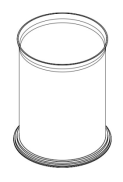
Key takeaway: Horizontal reactors remain the largest installed base in China. The density of the SiC coating on half-moon insulators and shields determines maintenance intervals. When selecting, focus on whether the coating shows micro-cracks or particle shedding.
Representative tools include LPE (now ASM) PE106/PE108, as well as domestic Jingsheng 150A/8-inch systems, NAURA MARS iCE series and CETC 48th Institute platforms. These hot-wall horizontal CVD systems feature gas flow parallel to the wafer surface with synchronized wafer rotation, achieving growth rates of 50–90 μm/h and good uniformity — hence the largest installed base, with hundreds of tools running in China.
Consequently, spare-part consumption is high. Most wear concentrates on half-moon insulators and shields, which are continuously exposed to high-temperature corrosive gases. Coating density directly governs service life. When replacing LPE PE106 spare parts, we recommend microscopic cross-section inspection for through-cracks — this is our internal first quality gate.

1.2 Vertical Epitaxy Systems (Nuflare Type) — Critical Metrics for TaC/SiC Coated High-Temperature Parts
Key takeaway: Vertical tools deliver extremely low defect densities (down to 0.02 cm⁻²), but the reliability of high-temperature rotating parts and susceptors directly determines equipment up-time. CVD TaC coating outperforms SiC coating in corrosion resistance and ultra-high-temperature stability, making it ideal for heater-class components.
Nuflare Epirevo S6/S8 are the flagship models — dual-chamber design, wafer rotation ~1000 rpm, and vertical downward flow that effectively suppresses particle settling. Domestic players such as Xin Sandai are also introducing similar dual-chamber vertical systems.
These tools involve high capital expenditure, so customers demand maximum part lifetime and process stability. Our measured data show that, under identical process conditions, TaC-coated heaters last approximately 30–40 % longer than SiC-coated ones because the corrosion rate of TaC in high-temperature chlorine-containing atmospheres is lower. Cost is higher, therefore our strategy is: heaters and rotation shafts → CVD TaC coating; large-area susceptors with moderate replacement frequency → CVD SiC coating. For Nuflare EPIREVO components , dynamic-balance verification after replacement is mandatory; we supply the report with every shipment.


1.3 Multi-Wafer Planetary Epitaxy Systems (Aixtron G10 Type) — Complete MOCVD SiC Hot Zone Solution
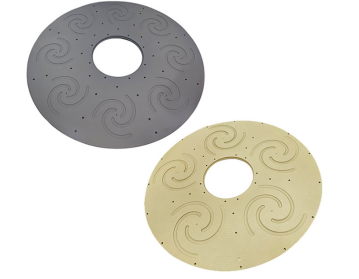
Key takeaway: Planetary reactors target high-volume production. Coating uniformity and thermal matching of the planetary disk (satellite disk / susceptor) determine wafer-to-wafer uniformity. In the 8-inch ramp-up, planetary disks with CVD TaC coating are the fastest-growing category.
Aixtron G5WWC / G10-SiC are the industry benchmarks, supporting simultaneous growth of 9 × 150 mm or 6 × 200 mm wafers. NAURA Satur C960 follows the same architecture. The core hot-zone part of warm-wall planetary designs is the planetary disk, which must carry multiple wafers under high-speed revolution + rotation while maintaining highly consistent temperature and flow fields on every wafer.
As 8-inch lines accelerate, customers demand tighter coating uniformity (we control within ±5 %) and better thermal-expansion matching. TaC coatings offer superior thermal-mismatch control because the CTE of TaC is closer to that of the graphite substrate, reducing delamination risk under thermal cycling. When selecting Aixtron G10 accessories or other MOCVD SiC hot zone parts, always request a thermal-cycle test report (RT → 1600 °C → RT, ≥50 cycles with no delamination) — this is a standard attachment in our technical proposals.

2. Our Differentiation: Why We Can Truly Offer a One-Stop Solution
Key takeaway: We are not a coating job-shop. We are a materials company that controls the full chain from graphite selection and CNC machining to CVD coating. Integrating three core technologies — CVD TaC , CVD SiC and Solid SiC components — under one company means customers no longer have to shuttle between vendors when “the coating peels” or “the substrate cracks.”
Specifically:
- CVD TaC coating: ultra-high-temperature and extreme corrosion resistance — used on heaters, rotation shafts and other core parts;
- CVD SiC coating: high purity, dense structure, low particle generation — used on susceptors, half-moon parts, shields and planetary disks;
- Solid SiC components: fully dense bulk material with zero coating-delamination risk — for the most reliability-critical applications;
- Vertical integration: high-purity graphite substrates machined in-house (CNC tolerance ±3 μm), CVD process parameters tuned by ourselves, final cleanliness and lifetime validation performed internally — the entire chain stays under one roof.
What does this mean? For us it is a closed quality loop; for you it is one phone call that solves every hot-zone issue. This is the essence of our one-stop SiC thermal field solution.

3. Four Questions Engineers Care About Most (FAQ)
Q1: How to choose between CVD SiC coating and CVD TaC coating?
It depends on the application. Prioritize CVD TaC coating for corrosion resistance and ultra-high temperature (heaters, rotation shafts). Choose CVD SiC coating when surface area is large, replacement frequency is high, and cost-performance matters (susceptors, half-moon parts, shields). If budget allows, we recommend TaC for planetary disks because of better thermal matching.
Q2: Are your parts truly interchangeable on LPE, Nuflare and Aixtron tools?
Dimensions and mounting interfaces follow the original OEM specifications of each brand, while coating process and substrate material are our own. Major domestic fabs are already running our parts as drop-in replacements for OEM parts, with lifetime feedback equal to or better than original.
Q3: What is the typical coating lifetime? Do you have test data?
It depends on process conditions (temperature, atmosphere, growth rate). Under our standard test conditions (1600 °C, Cl₂ atmosphere, continuous operation): CVD SiC coating ≥ 500 hours, CVD TaC coating ≥ 800 hours. For each specific tool we can provide a free lifetime assessment.
Q4: What is the minimum order quantity (MOQ)? How do custom parts work?
There is no hard MOQ; first orders can be supplied according to actual demand quantity. For custom parts, simply provide drawings (or scan an existing part for reverse modeling); we deliver a technical proposal and quotation within 7 days.
Closing
We are committed to providing comprehensive and locally controllable material solutions that help the Chinese wide-bandgap and compound semiconductor industry achieve high-quality development. As a company that truly understands the stringent material requirements of SiC epitaxy processes and has mastered the full portfolio of TaC, SiC coatings and solid SiC, Semixlab is ready to support you. Our team includes veteran engineers from front-line fabs as well as materials-science PhDs. If you are currently selecting parts or facing any hot-zone technical issue, feel free to contact us — simply note “Epitaxy Hot Zone Technical Consultation” and we will reply promptly. We can discuss process-matching solutions or arrange sample shipments for your evaluation.
About Semixlab
Semixlab is a national-level “Specialized, Refined, Distinctive and Innovative” (专精特新) little-giant enterprise focusing on CVD TaC/SiC coating and Solid SiC components for the global SiC epitaxy and third generation semiconductor / wide bandgap semiconductor markets, delivering a true one-stop SiC thermal field solution.
Founded in 2018, Semixlab Technology Co.,Ltd is a technology-based enterprise focusing on the research and development, production and sales of advanced materials. It is a world-leading semiconductor material manufacturer.